Built Bright For VisionAir
VisionAir is the authorized Rainbow distributor for Albuquerque. Owner Maya Sky sells a water-based cleaning system and air purifier through free in-home demonstrations, not a storefront. CheatCode Solutions built her a ten-page custom site around that reality: book the demo, answer the questions, keep the documentation on the site.
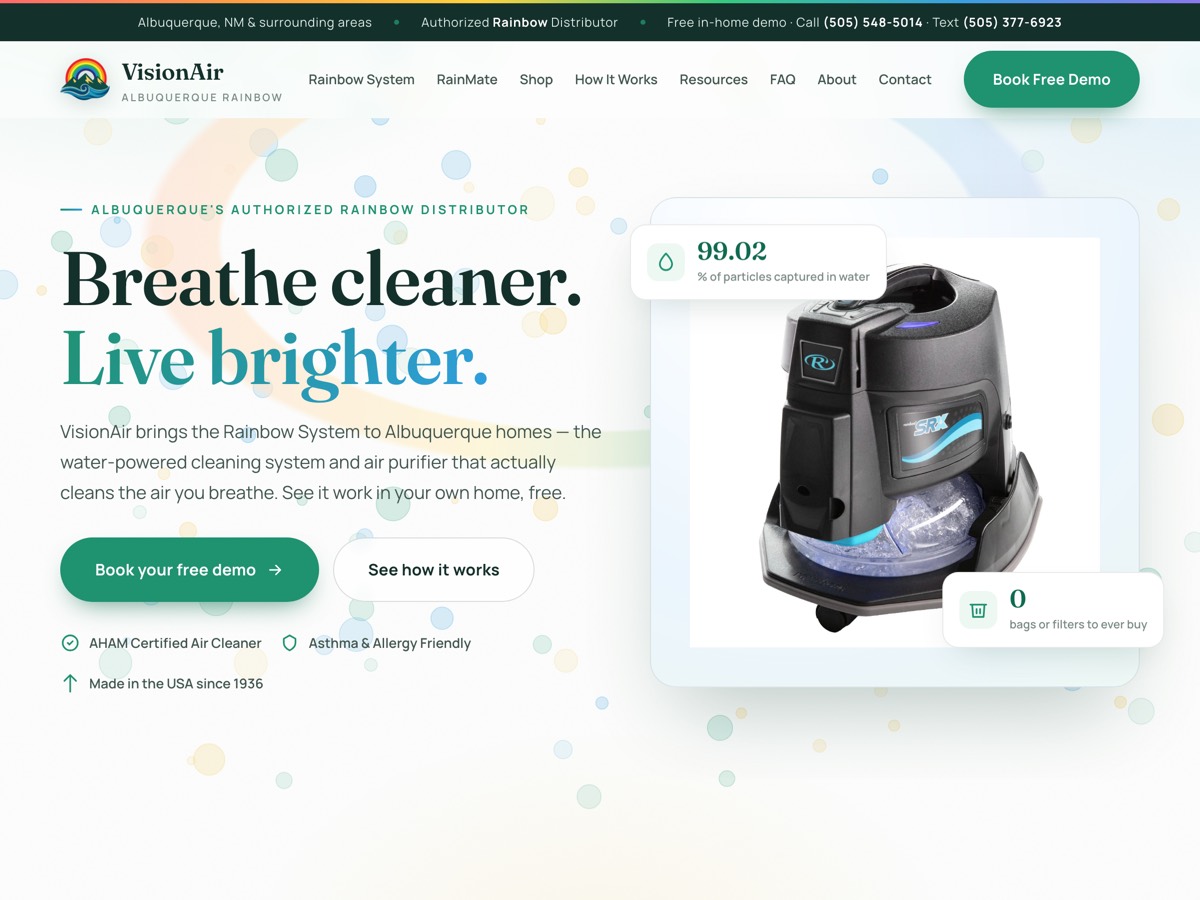
The business runs on demos, so the site does too
Rainbow does not sell off a shelf. The system goes into the home, the demonstration happens in the room, and the sale follows from there. So every page on visionairnm.com points at one action: Book a Demo. Home, Rainbow System, RainMate, How It Works, FAQ — each one ends where the business actually starts.
Ten pages, all hand-coded: Home, Rainbow System, RainMate, Shop, How It Works, Resources, Book a Demo, FAQ, About, Contact. Shop is an order-request catalog rather than a checkout, because VisionAir's customers order through Maya, not through a cart. The site takes the request and routes it to her.
We threw out our own palette
CheatCode's house style is near-black and neon green. Maya wanted bright — light green and blue. So the whole system got inverted for her: teal-green, sky-blue and warm white, with rainbow color used sparingly as an accent rather than as the theme. Fraunces for headlines, Manrope for everything else, and a soft rising-bubbles canvas moving behind the content.
This is the part a template cannot do. A template hands you somebody else's palette and asks the client to live inside it. Custom code means the design follows the client. Maya asked for bright, and the site is bright, in her colors instead of ours. Rainbow is a brand with real visual equity, and the accent work had to respect that without swallowing the page.
The resources library stays on the site
Most distributor sites hand owners a link to somebody else's documentation portal and lose them there. VisionAir keeps it in-house. Everything an owner or a shopper needs is on the site, on VisionAir's domain, under VisionAir's design.
The lazy-loading matters more than it sounds. Twelve embedded videos loading eagerly would make Resources the slowest page on the site. They load when a visitor asks for them and not a moment earlier.
- Nine Rainbow owner's manuals, hosted on the site
- A fault-code guide for owners troubleshooting a machine
- Twelve how-to videos, embedded and lazy-loaded
- A cleaning-tips accordion for everyday questions
- The AHAM Certified and Asthma & Allergy Friendly certifications, in front of buyers while they are deciding
Forms that actually send
Contact, demo-request and shop-request forms post to a serverless function that emails the business directly. No third-party form widget, no dashboard to log into, no submissions piling up in a database nobody opens. The customer's address is set as reply-to, so Maya can read the notification and hit reply — the answer goes straight to the customer.
The notification email uses a branded template styled to VisionAir rather than to CheatCode. Every message the site sends looks like it came from her business, because it did. Contractors who bolt a form plugin onto a page skip this step, and the client ends up forwarding emails to themselves to answer them.
The details most sites get wrong
None of this shows up in a screenshot. All of it shows up the moment a real customer on a real phone tries to reach the business.
- Call and Text are separate paths. The office line takes calls, a mobile number takes texts, and every contact point on the site offers both, routed to the right one.
- The Visit Us link opens the visitor's own default maps app: Apple Maps on iPhone and Mac, the Android default through a geo link, Google Maps on desktop. Hardcoding Google makes half your visitors take an extra step.
- A sticky mobile call bar, laid out so Call, Text and Book Demo never crowd each other on a small screen.
- Service area stated plainly — Albuquerque, Santa Fe and surrounding areas — so nobody books a demo outside the drive.
Ten custom pages where the design followed the client's colors instead of a template's, nine manuals and twelve videos that stay on the site instead of linking away, and every form emailing the business directly with the customer's address as reply-to.
What the build does
Questions, answered
Can you build in our brand colors even if they are nothing like yours?
Yes, and VisionAir is the proof. Our house style is near-black and neon green. The site we shipped for Maya is teal-green, sky-blue and warm white. We write the CSS ourselves, so there is no template palette to fight and no builder theme to override. Send us your colors, or describe the feel you want, and we build to that.
How long would a build like this take?
Most CheatCode builds live in two to four weeks. VisionAir sat at the heavier end of that: ten pages, a forms backend, a hosted resources library and a dozen embedded videos. Hosting, SSL and support are included after launch, and there is no contract to sign.
What happens after launch — who maintains the forms and hosting?
We do. Hosting and SSL are included. The form backend is a serverless function we wrote, so there is no monthly form service in the stack and nothing to renew. Brady Smith writes the code and runs the calls, so when you need a change you are talking to the person who makes it.
Keep going
Tell us what you are building
CheatCode Solutions is Brady Smith in Rio Rancho, writing the code and taking the calls. Most builds ship in two to four weeks with hosting, SSL and support included, and no contract.